Context
In Brazil, the neighbourhood social network role falls to WhatsApp and Facebook groups, improvised and fragmented: no search, no history, no neighbourhood verification. The Brazilian apps with a similar proposition concentrate on the state capitals and don't reach smaller inland cities — and in the survey I ran, none brought neighbourhood verification, a services directory and transparent moderation together in a single product. HelpCiti was built to close that gap: a hyperlocal network designed from scratch for people who live outside the major urban centres.
The Problem Behind the Problem
Before designing a single screen, I investigated why the existing options fell short. The pattern that emerged wasn't about features, it was about geography: the available products were built for a neighbourhood inside a state capital, where a neighbourhood is a small slice of a large city. Applied to a town of 40,000 people, that slice simply doesn't describe how people live.
I validated demand in the field: I analysed "Fala Socorrense," a Facebook group with 38,000 members in the pilot city (Socorro, São Paulo state, population ~40,000). The most important finding wasn't on a feature list, it was structural: in a small city, the functional neighbourhood is the whole municipality, not the district. That single insight redesigned the product's entire geographic model, from the data hierarchy to each post's visibility scope.
From Research to Product
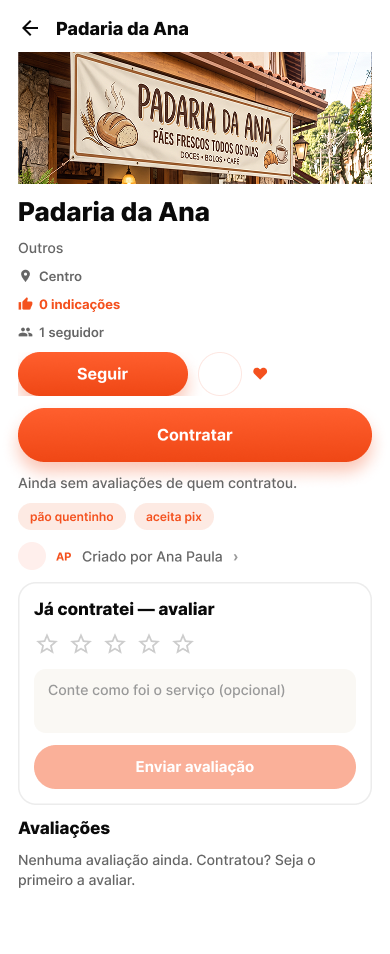
The research also surfaced the anchor use case: asking for and giving referrals for a service provider (electrician, cleaner, caregiver) was, by far, the number-one reason people used the group. That reordered technical priorities: the services directory, initially planned for a later phase, was brought forward into the product's core.
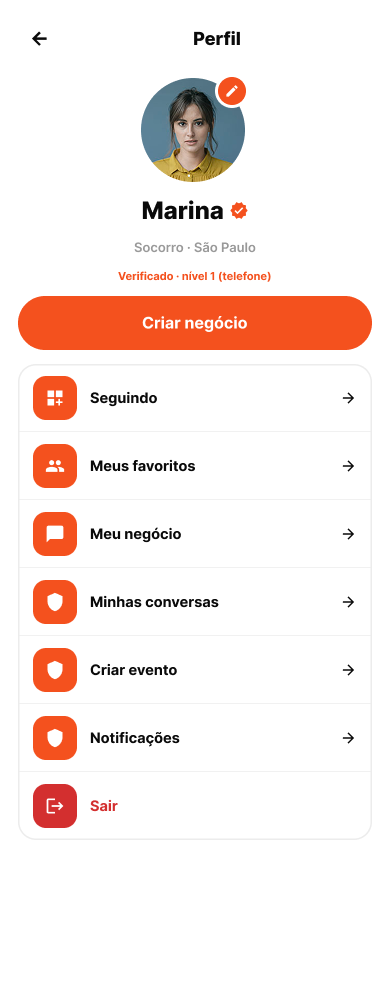
Trust by design was built rule by rule, answering what the improvised groups lack: progressive verification (phone → postal code → geolocation, ID document never required), a user's exact address never exposed to third parties, and an AI moderation pipeline that logs the reason and the rule broken for every action, keeps an auditable appeal window, and treats sensitive content — mental health, domestic violence — with support rather than automatic removal.
The Pivot: When Usability Testing Contradicts the Plan
The product's first version used a hybrid home screen: a chronological feed as the backbone, with task shortcuts and service modules interspersed, a deliberate design meant to balance two needs observed in the research, getting a task done and keeping up with neighbourhood life.
Usability testing with real users, all ages, entry-level Android devices, varied digital literacy, showed something else: the feed as the main structure competed with the task instead of supporting it. Users arrived with a concrete need and the feed became an obstacle, not a shortcut.
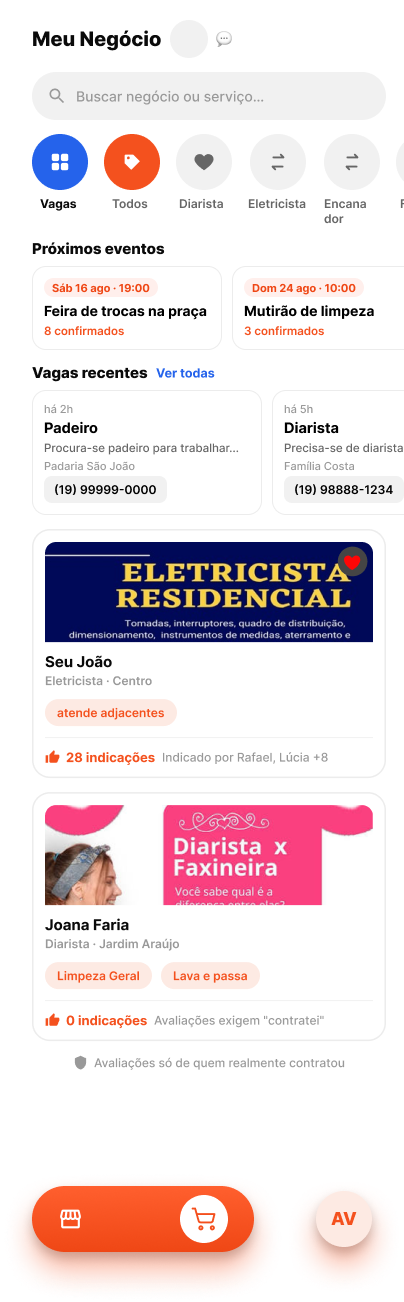
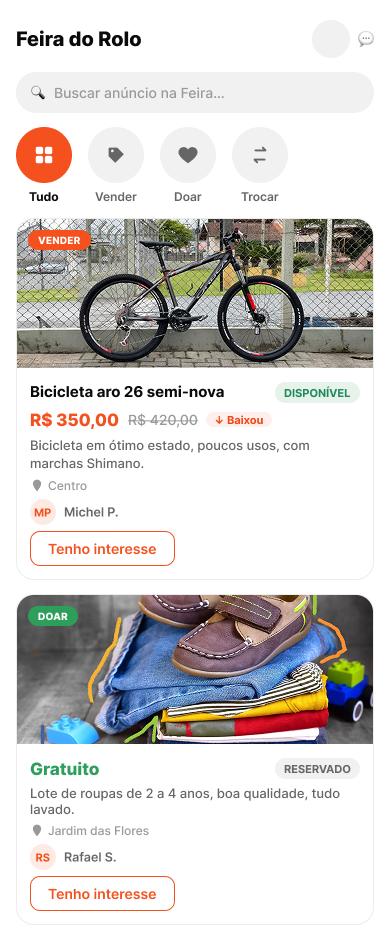
The answer was an information-architecture pivot, not a detail tweak: the feed moved out of the mobile app's centre, and the product came to live in two task tabs, Meu Negócio (services and gigs) and Feira do Rolo (buy, trade and donate). The feed backend stayed alive in the architecture, preserving the option to reintroduce it differently as the product evolves, but the interface stopped assuming that scrolling was the default behaviour.
Architecture and Technical Decisions
The system was built as a monorepo (React Native/Expo, NestJS, PostgreSQL with PostGIS for the geospatial model, Redis/BullMQ for queues), hosted in the cloud in Brazil, compute and database in the same region, for low latency and data residency aligned with LGPD. The AI layer (Claude API) handles content moderation and feed/digest personalisation, always with data minimisation and auditable decisions, never a black box removing content without explanation.
The entire process, from market research to the engineering roadmap, was documented and executed in granular stages with AI as a development pair, letting a single designer/developer sustain the full cycle of discovery, design and implementation.
Results
HelpCiti is in production, with an active beta in the pilot city. End to end, the project brings together primary market research, trust architecture and privacy by design, and an evidence-driven product pivot, proof that the initial design is a hypothesis, and that the willingness to change it in the face of testing is what separates a usable product from a well-intentioned one.